One good idea is rarely one video.
It may contain a question, a mistake, a method, an example, an objection and a story. When you force all of that into one recording, the result is often rushed. When you publish the same recording ten times with different captions, the result is repetitive.
There is a better approach. Keep the central idea, but change the job each video performs.
This guide shows you how to turn one idea into 10 videos without making your audience feel as if they have watched the same post ten times. You can use the method for educational content, personal brands, product marketing and client work. AI can speed up parts of the process, but the system works because of editorial judgment, not automated volume.
Repurposing is not copying and pasting
Three activities are often confused.
Reposting means distributing the same video again. That can be useful when most of your audience did not see the original, but it does not create a new piece of content.
Reformatting means adapting an asset for another channel. You might crop a landscape interview into a vertical clip, add captions and shorten the opening. The presentation changes, but the message remains largely the same.
Repurposing means returning to the source material and developing a different useful argument from it. The new video may address another viewer, answer another question or use another kind of proof.
The distinction matters because audiences do not object to a creator having a recognisable subject. They object to receiving no new value.
Do not ask how many clips you can extract from one recording. Ask how many useful questions the original idea can answer.
Begin with an idea that can carry weight
A weak source idea produces thin variations. "AI is changing content" is broad, familiar and difficult to prove. "AI can shorten production, but it cannot decide what your audience needs to hear" creates productive tension. It contains a claim that can be explained, challenged, demonstrated and applied.
Before multiplying an idea, write one sentence that contains:
- the person who has the problem;
- the specific problem;
- your position on that problem;
- the change the viewer should make.
For example:
Small business owners who ask AI for daily video ideas often produce generic content because they begin with formats instead of customer questions; they should build their content around problems they repeatedly hear.
If those questions are not yet clear, this practical approach to market research and positioning will help you find the language customers already use.
That sentence has enough substance for a series. It identifies an audience, names a cause and proposes a correction.
The 10-video angle system
Use the following ten angles as editorial prompts. They are not ten opening lines for the same script. Each one should result in a video that can stand on its own.
1. State the central claim
Make the clearest version of your position. Explain what you believe, who it affects and why it matters now.
Using our example, the first video might be: Your customers are a better source of video ideas than an AI idea generator.
This becomes the anchor for the series. It should establish the subject without trying to cover every supporting point.
2. Expose the common mistake
Show the behaviour that keeps creating the problem. Be precise enough for the viewer to recognise it in their own work.
Example: Why asking ChatGPT for 30 random content ideas usually gives you content that sounds like everyone else.
A mistake video earns attention through recognition. It should also explain the consequence, not merely mock the person making the error.
3. Teach the method
Give the viewer a small process they can apply. This is where a framework, sequence or decision rule becomes useful.
Example: Turn your last five customer questions into next week's video plan.
Show the actual steps. Open the messages, remove private details, group similar questions and choose the one with the highest commercial relevance.
4. Show a real example
Move from advice to evidence. Apply the method to a believable business and reveal how the idea changes.
Example: take a skincare seller who repeatedly hears, "Will this product work for oily skin?" Then show how that question becomes a demonstration, a myth correction, a customer story and a product-selection guide.
Specific examples make abstract advice easier to trust.
5. Answer the strongest objection
Ask what a thoughtful viewer would disagree with. An objection is often more valuable than another tip because it helps the audience decide when your advice applies.
Example: What if customers keep asking questions I have already answered?
Your response might explain that new followers have not seen the old answer, the market may have changed and a repeated question is evidence of continuing demand. Then show how to update the answer instead of simply reposting it.
6. Compare two approaches
Comparison creates clarity when the difference can be shown fairly.
Example: Random content calendar versus customer-question content calendar.
Place both approaches beside each other. Compare the source of the idea, the relevance to buyers, the evidence required and the likely next conversation. Do not invent a weak alternative only to make your method win.
7. Tell the story behind the lesson
People often remember the moment that changed your mind more clearly than the instruction that followed.
Example: tell the story of publishing a polished video that attracted little response, then answering one ordinary customer question and receiving several useful enquiries.
A good story needs a situation, a decision and a consequence. It does not need a dramatic personal transformation that never happened.
8. Give a checklist
Turn the idea into a quick evaluation tool.
Example: before recording a customer-question video, check whether the question is specific, whether you can answer it from experience, whether the answer needs a demonstration and whether the viewer will know what to do next.
Checklist videos are useful when each item changes a decision. Avoid filling them with obvious instructions just to reach a larger number.
9. Demonstrate the process
Let the viewer watch the work happen. Screen recordings, documents, physical products and before-and-after comparisons can replace unsupported claims.
Example: start with one customer message, highlight the central question, write three possible hooks, select one and arrange the answer into a hook, body and close.
This structure aligns with TikTok's first-party creative guidance, which recommends a hook, body and close. The principle is broader than advertising: the opening earns attention, the body delivers the value and the ending completes the thought.
10. Respond to the audience
The final angle should not be planned in isolation. Publish some of the earlier videos, then inspect the questions, disagreements and moments people repeat back to you.
Example: if viewers ask whether AI can analyse customer messages, create a response that shows what the tool can organise, what data should remain private and why the final topic still requires human selection.
This makes the series a conversation rather than a content factory.
A complete example from one idea to 10 videos
Start with this source idea:
People can recognise that a video uses AI. The bigger problem is when the video has no clear human direction.
Here is how it becomes ten distinct videos:
- Claim: An AI-looking video is not automatically a bad video.
- Mistake: Generating scenes before writing the message.
- Method: A five-question brief to complete before opening an AI tool.
- Example: Rebuilding a vague motivational video around one practical lesson.
- Objection: Does visible AI reduce trust?
- Comparison: Tool-led production versus idea-led production.
- Story: The first time a beautiful generated scene failed to support the script.
- Checklist: Seven signs that an AI video still needs editing.
- Demonstration: Turning one paragraph into a shot list.
- Response: Answering the most useful comment from the first nine videos.
The subject remains consistent. The value changes every time.
Use AI to expand the map, not manufacture authority
AI is useful after you have supplied the source material. Give it your central claim, customer questions, notes, examples and boundaries. Then ask it to identify distinct angles.
A practical prompt could be:
I am creating a video series for [specific audience]. The source idea is [one-sentence idea]. Based only on the notes below, identify ten different viewer questions this idea can answer. For each question, suggest a clear promise, the proof required and the best visual format. Do not invent statistics, experiences or customer results. Flag any angle that repeats another.
Review the output with three questions:
- Do I have enough experience or evidence to make this video?
- Does it solve a different viewer problem?
- Would it still be worth publishing if the other nine videos did not exist?
Delete weak angles. Ten is a useful exercise, not a compulsory publishing target.
This follows the same principle as my seven-step AI video workflow: the tool should support a plan, not replace one.
Adapt the idea to the platform without losing it
Do not assume that every platform requires an entirely different personality. The useful idea should survive. The packaging may change.
A short vertical video may begin with the conclusion and prove it quickly. A longer YouTube video can establish context, compare options and show the process in more detail. A LinkedIn video may need enough written context to help a silent scroller decide whether to press play.
YouTube's own performance guidance separates appeal, engagement and satisfaction. That is a useful way to review each variation:
- Appeal: does the title, opening frame or caption give the right viewer a reason to choose the video?
- Engagement: does the video continue delivering what the opening promised?
- Satisfaction: did the viewer receive a useful answer rather than an empty hook?
These questions are more dependable than copying the editing style of whichever creator went viral yesterday.
Build the series in one production cycle
Multiplying ideas should reduce production friction, not create ten times the chaos.
Use a simple cycle:
- Collect: gather your notes, customer language, examples and evidence in one source document.
- Map: assign the idea to distinct angles and remove overlaps.
- Script: write one clear promise and one conclusion for each video before filling the middle.
- Plan: decide which videos need your face, a screen recording, a product, a diagram or generated visuals.
- Record: batch similar setups while changing the delivery enough for each video to have its own rhythm.
- Edit: finish the strongest three first. Do not let a ten-video plan delay every publication.
- Publish and learn: use audience response to revise the remaining scripts.
Keep the visual system consistent through type, captions, colour and sound. Keep the editorial experience varied through examples, pacing and format. Your wording should also remain recognisably yours, which is why a clear brand voice and tone matters even when AI helps with the first draft.
If you would like to watch this planning process applied to an actual video, I will teach it during the free AI Video Content Blueprint webinar. The session shows the thinking between an initial idea and a coherent finished video.
Measure the idea, not only the individual post
A series gives you more useful information than a single upload because the subject stays relatively stable while the angle changes.
Track:
- which promise persuaded people to begin watching;
- where attention dropped;
- which examples were rewatched or shared;
- which videos produced thoughtful comments or direct questions;
- which angle attracted the people you actually want to reach.
YouTube's key moments for audience retention report identifies dips, spikes and top moments. Those signals can show where viewers skipped, rewatched or stayed. Use that evidence to decide what deserves a deeper follow-up.
Do not copy the top-performing hook and attach it to every future video. Study why it worked. Perhaps the promise was more specific, the example appeared earlier or the audience immediately recognised the problem.
Common ways content multiplication goes wrong
Changing the hook but keeping the same lesson
Ten openings do not create ten videos when every body reaches the same conclusion through the same example.
Stretching a shallow idea
Some ideas should remain one concise post. If the variations require filler, publish the useful version and move on.
Letting AI invent the proof
A confident script is not evidence. Supply the examples, verify factual claims and remove any personal experience that did not happen.
Ignoring what the audience tells you
A content plan should be firm enough to create momentum and flexible enough to absorb a better question.
Publishing for volume alone
Google's guidance on helpful, people-first content warns against producing large amounts of automated content across topics merely to attract search traffic. The same editorial test applies to video: create the series because it helps an intended audience understand the subject, not because an AI tool can fill a calendar.
A planning template you can reuse
Complete this before scripting:
- Audience: who specifically needs this?
- Problem: what are they trying to understand or change?
- Source idea: what is my one-sentence position?
- Evidence: what have I observed, tested or documented?
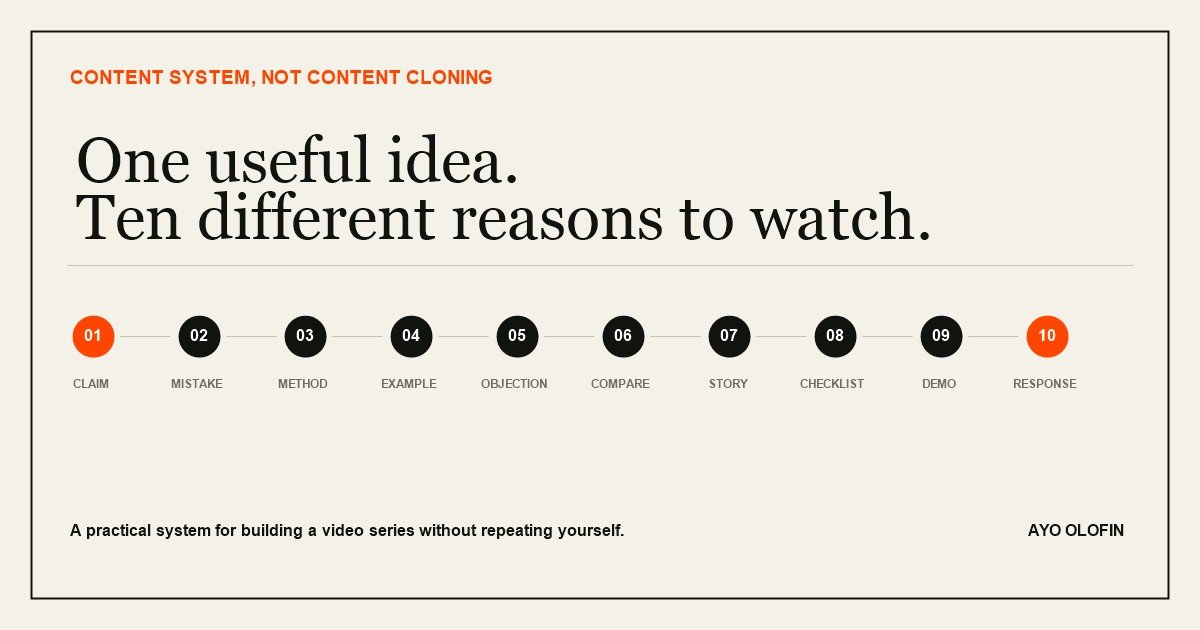
- Ten angles: claim, mistake, method, example, objection, comparison, story, checklist, demonstration and response.
- Format: which visual treatment makes each answer clearest?
- Sequence: what should be published first, and what can wait for audience feedback?
- Measure: what viewer behaviour would show that the answer was useful?
The rule to remember
One idea becomes ten useful videos when you deepen it, not when you duplicate it.
Find the questions hidden inside the subject. Give every video one job. Use proof where proof is available. Let early audience response improve what comes next.
AI can help you see more possibilities and move through production faster. Your judgment determines whether those possibilities deserve anyone's attention. That distinction becomes even more important as the capabilities and commercial impact of AI continue to expand.
Loading the conversation...