
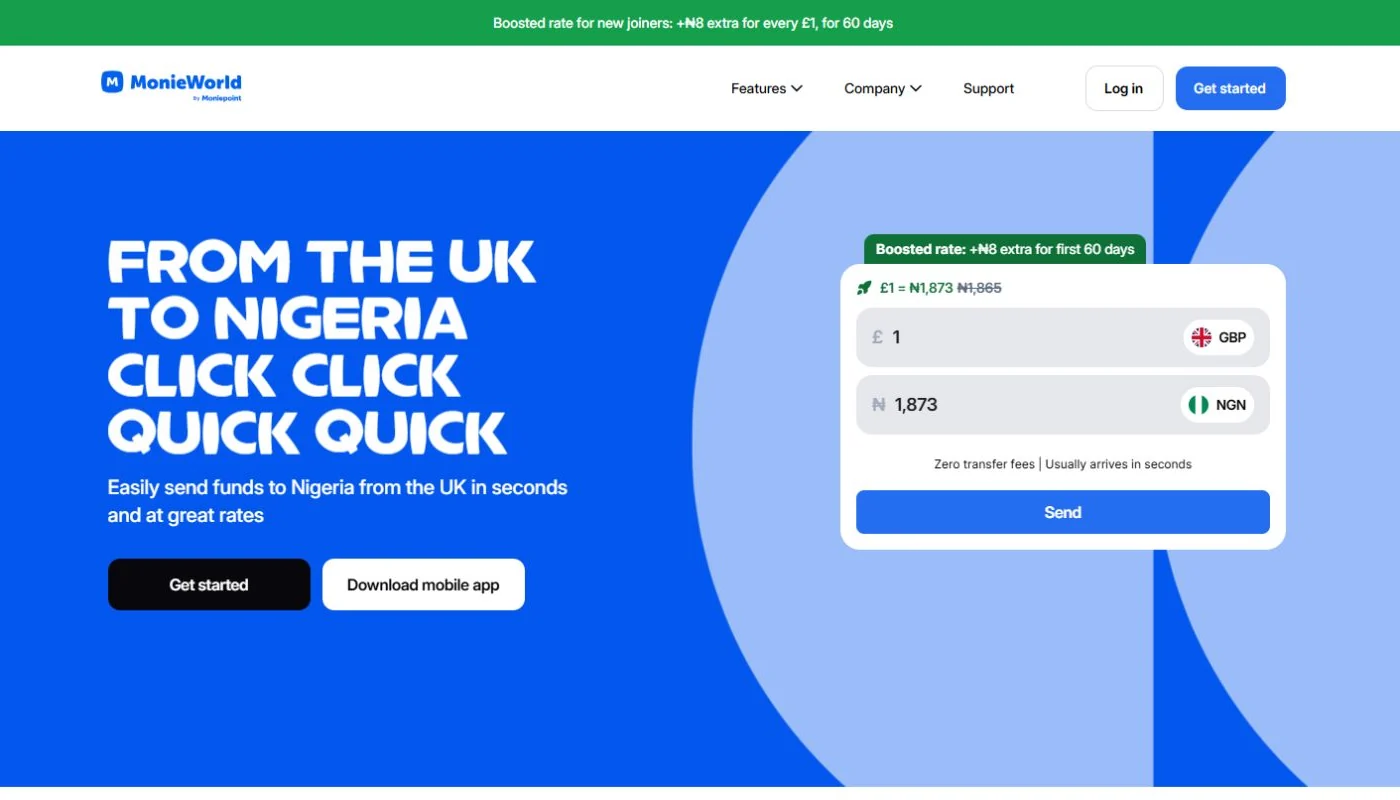
Moniepoint is winding down MonieWorld, its UK remittance and diaspora-finance product, barely sixteen months after launch.
The decision was communicated to customers on 25 August 2026. MonieWorld is not disappearing in one sudden switch-off. The app remains operational for now, but it has entered a transition that will end with the product closing.
That distinction matters. Customers do not need to panic, but they do need to prepare.
The business question is just as important. MonieWorld entered one of the world's most valuable remittance corridors with Moniepoint's brand, engineering, Nigerian payment infrastructure and investor backing. The company says monthly transaction volume grew by 70%. Yet it still chose to leave.
Why would a well-funded fintech shut a growing product? The honest answer sits between the company's official explanation and what its numbers do not tell us.
My view is that MonieWorld did not lose because Moniepoint cannot build good technology. It lost the internal argument for more capital because Moniepoint's strongest distribution advantage lives in African business banking, while UK remittance required it to win a different customer, through different channels, against specialists with established habits and aggressive pricing.
Evidence standard: this analysis separates company-confirmed facts, reported claims and my professional interpretation. Moniepoint has not published MonieWorld's full unit economics. Where the data does not support a definitive conclusion, I say so.
This is what has been confirmed, what people are debating on X, what remains unknown, and what the closure says about taking an African fintech into the United Kingdom.
What exactly has Moniepoint announced?
Moniepoint has confirmed that MonieWorld is entering a phased wind-down as the group focuses strategic resources on financial tools for businesses across Africa.
In the message reported from MonieWorld customers, the company described a transition over the coming months. It said the app would continue operating for the time being and that customers would receive advance notice before features were suspended.
So the accurate position on 27 August 2026 is:
- MonieWorld is being closed;
- the closure is phased rather than immediate;
- the app remains available for current customers at the moment;
- no final public shutdown date has been announced;
- customers will be contacted before individual services change.
Some headlines say the product closed after fourteen months. The official launch announcement is dated April 2025, while the wind-down was communicated in late August 2026. That is roughly sixteen months. The broader description, less than eighteen months after launch, is the safer one.
What MonieWorld was supposed to become
MonieWorld launched as Moniepoint's first customer product outside Africa. Its opening use case was simple: let people in the UK send pounds directly to Nigerian bank accounts using bank transfers, cards, Apple Pay or Google Pay.
The ambition was much larger than money transfer.
At launch, Moniepoint CEO Tosin Eniolorunda told TechCrunch that the goal was to build a broader financial platform for immigrants. Remittance was the entry point. GBP accounts, payment cards, scheduled transfers and direct payment of Nigerian bills were meant to make the app part of a customer's everyday financial life.
Moniepoint put a serious team behind the idea. Its own account of the build described a project that started in February 2024, took about a year to launch and grew from roughly ten people to nearly sixty by the end of one quarter. The full launch effort involved around eighty staff across product, engineering, compliance, marketing and support.
This was not a weekend experiment. It involved dedicated technology, regulated partners, customer acquisition, compliance operations and eventually a UK electronic-money institution.
Why Moniepoint says it is closing MonieWorld
The official reason is focus.
Moniepoint says it reviewed its portfolio and long-term priorities, then decided that the capital, technology and operational structure behind MonieWorld should be redirected towards its core African markets.
That explanation is credible. Moniepoint's strongest business is not consumer remittance. It is the payment, banking, credit and business-management infrastructure used by African merchants. The company says it now serves more than 20 million businesses and individuals each month and processes more than $250 billion in annual digital-payment value.
It is also expanding inside Africa. In Kenya, Moniepoint acquired a majority position in Sumac Microfinance Bank and appointed experienced local leadership. In Nigeria, it can add credit, bookkeeping, cards and payments around a merchant relationship it already owns.
Every pound and every senior hour placed into MonieWorld therefore had an opportunity cost. The question was not only whether the UK product could grow. It was whether that growth could produce a better return than adding depth to Moniepoint's African business platform.
A product can be improving and still lose the internal competition for capital.
That is the clearest way to understand this decision.
How can transaction volume grow by 70% and still not be enough?
The 70% figure has become the most repeated detail in the story. It is also the easiest one to misuse.
Moniepoint reported a 70% increase in monthly transaction volume among UK diaspora users. It did not disclose the starting volume, the exact period measured, customer numbers, total transaction value, revenue, gross margin, retention or customer-acquisition cost.
If monthly transactions rise from 10,000 to 17,000, that is 70% growth. If they rise from one million to 1.7 million, that is also 70% growth. The commercial meaning is completely different.
Volume is not revenue, and revenue is not profit.
Remittance companies commonly earn through an exchange-rate margin. To attract users, they may offer boosted rates, referral rewards or fee-free transfers. Those incentives can grow transaction volume while compressing the amount earned on each transfer.
Moniepoint's own February 2026 engineering article is revealing. It said the team rebuilt its boosted-rate system after transaction patterns showed a need to re-engage users. The promotion gave new customers an improved rate for sixty days and produced an estimated 20% to 30% increase in processing volume.
That is evidence that promotions could move the number. It is not evidence that the resulting activity was profitable or that customers stayed after the subsidy ended.
The company has not released enough information to calculate MonieWorld's commercial performance. It has released enough information to say that percentage growth alone did not justify continued investment.
The numbers that would settle the argument
If I were reviewing this business as a growth operator, transaction count would be a secondary number. I would ask for seven measures:
- Active funded customers. How many verified users completed at least one transfer in the month?
- Repeat rate. What percentage sent money again after 30, 60 and 90 days?
- Net revenue per transfer. What remained after the customer received the quoted exchange rate?
- Contribution margin. What remained after payout fees, funding costs, promotions, fraud losses, compliance checks and customer support?
- Customer-acquisition cost. How much did MonieWorld spend to acquire one customer who completed a transfer?
- Payback period. How many months of contribution margin were required to recover that acquisition cost?
- Organic share. How much growth came from referrals and repeat behaviour rather than paid campaigns and boosted rates?
Without those numbers, neither side of the online debate can prove its case. A 70% rise can describe excellent product-market fit, a promotional spike from a small base, or something between the two.
The UK-to-Nigeria corridor was more competitive than the launch story suggested
MonieWorld entered a market already occupied by LemFi, Taptap Send, NALA, Wise, Remitly, WorldRemit, Send by Flutterwave and other regulated providers.
Remittance looks simple on a screen. Pick a recipient, enter pounds and send. Behind that screen, a provider must manage identity checks, fraud, safeguarding, liquidity, foreign exchange, local payouts, customer complaints, regulatory reporting and relationships with banks or payment partners.
The fixed cost is high. The visible product is easy to copy. The buyer can compare rates in seconds.
There is also a habit problem. A customer who has used the same app for years and trusts its delivery does not switch permanently because another provider offers a small temporary rate advantage. A new entrant has to spend to create awareness, subsidise trial and prove reliability. The established provider mainly has to avoid breaking trust.
At launch, Moniepoint told TechCabal it wanted MonieWorld to become a top-two provider on the UK-to-Nigeria corridor before entering more markets. There is no public evidence that it reached that position.
Big Tech This Week reports, citing sources close to the company, that the corridor proved more competitive than expected and that MonieWorld's assets are being offered to potential buyers. Moniepoint has not publicly confirmed the proposed sale, so that part should be treated as reporting rather than settled fact.
What people on X are saying about the shutdown
The public conversation is useful because it exposes the questions the official statement does not answer. It is also full of category errors.
Fatu Ogwuche's original report on X said intense competition in the UK-to-Africa corridor drove the decision and that MonieWorld was looking for potential buyers. The post had passed one million views when I reviewed it. The size of the response shows how quickly the story became a wider argument about whether Nigerian fintech models can travel.
One of the most widely shared reactions claimed that some business models cannot work in a stable, tightly regulated economy and used Nigeria's agency-banking terminals as the example. That is a weak comparison. The thread itself attracted replies pointing out the mismatch: MonieWorld was a consumer remittance product, not an attempt to replace British cash machines with Nigerian-style POS agents.
Another part of the discussion focused on incumbency and price. Tosin Olugbenga argued that established competitors had a head start. In the replies, one person who said he had used MonieWorld reported deleting the app after finding better rates elsewhere. That is one customer's account, not market research, but it illustrates the problem clearly. When the product is trusted to move money and the visible difference is the exchange rate, customers can switch quickly and margins come under pressure.
A third view described the exit as smart capital allocation because remittance margins are thin and Moniepoint's core can still be optimised. That interpretation is commercially plausible, but it is still an interpretation. The public data does not reveal MonieWorld's margin or payback period.
What the X conversation gets right
- The UK-to-Africa remittance market is crowded.
- Exchange-rate competitiveness can overpower brand recognition.
- Specialist providers have customer habit and category trust.
- Moniepoint has stronger opportunities inside its African business platform.
What the X conversation gets wrong
- MonieWorld's closure does not prove that Moniepoint only works because Nigeria is dysfunctional.
- Moniepoint's Nigerian merchant and agency-banking model is not the same business as UK consumer remittance.
- The reported 70% growth does not prove success without a baseline, retention and margin.
- A possible asset sale is not confirmed merely because sources say buyers are being approached.
The loudest social-media explanation is not automatically the strongest one. The serious question is not whether Britain rejected an African fintech. It is whether MonieWorld could acquire and retain UK customers at a cost that made the wider diaspora-finance strategy worth funding.
My professional view: distribution was the strategic gap
Moniepoint's advantage in Nigeria is not only its software. It is distribution. The company sits inside the daily operation of millions of businesses. A merchant that already accepts payments through Moniepoint can be offered an account, card, bookkeeping tool or credit product through a relationship that already exists.
MonieWorld started from a different position. It had to acquire individual consumers in Britain, persuade them to trust a new money-transfer brand, offer a competitive rate, pass compliance checks, complete the transfer reliably and then give them a reason to return when another app displayed a better rate.
That is not a small extension of the Nigerian model. It is a different go-to-market system.
The strategic plan was to use remittance as the first product, then expand into a broader financial home for immigrants. That plan only works if the first product creates cheap, durable distribution for the products that follow. If customers arrive mainly for a subsidised exchange rate and leave when the promotion ends, the entry product does not create the platform advantage the company needs.
Regulatory permission can get a fintech into the market. It cannot make customers stay.
This is why I would describe the outcome precisely. MonieWorld was a failed expansion thesis, because the product is being retired before reaching the strategic position it was built to achieve. The decision to stop funding that thesis can still be disciplined management. Product failure and good capital allocation can be true at the same time.
How much did the UK expansion cost?
The public numbers show why the decision mattered even before marketing spend is considered.
Moniepoint GB's Companies House filings include accounts for the period to December 2024. Reporting on those accounts initially described a roughly £1.2 million loss. Moniepoint later clarified that the amount represented setup, administration and infrastructure spending during a pre-revenue phase, not a mature product's operating shortfall.
The distinction is fair. MonieWorld did not launch until April 2025, so 2024 was a build year.
It still shows the cost of entry. According to the company's clarification reported by Nairametrics, the UK operation spent on technology, compliance, service infrastructure and people. Moniepoint also placed $2.5 million as an equity deposit for its acquisition of Bancom Europe, an FCA-authorised electronic-money institution later renamed Moniepoint UK Limited.
TechCabal separately reported that Moniepoint had earmarked about $7.39 million for the London expansion.
None of those figures proves that the company ran out of money. Moniepoint is a large, well-funded and profitable group. They show something else: continuing in the UK required more than maintaining an app. It required a regulated business, compliance staff, support, banking relationships, pricing incentives and sustained customer acquisition.
This is a retreat, not a collapse of Moniepoint
MonieWorld closing does not mean Moniepoint itself is failing.
The group is closing one consumer product outside its core market and redirecting resources to businesses where it already has scale. Most MonieWorld employees are expected to move into other positions within the group, according to reporting on the company announcement. Affected staff have been informed and supported through the transition.
The decision also does not automatically mean Moniepoint is abandoning every UK company or surrendering its FCA permissions. MonieWorld is the product being wound down. What happens to Moniepoint UK Limited, its licence, infrastructure and customer assets has not been set out in a full public company statement.
If reports of a sale process are correct, the regulated infrastructure may retain value even though the original product strategy has ended.
What MonieWorld customers should do now
MonieWorld says there is no immediate change. That gives customers time to prepare carefully.
- Read every official notice. Check the email attached to your account and messages inside the app. Closure dates copied from social media may be wrong.
- Review your balance. Know exactly how much money is held in the GBP account and whether any transfer is pending.
- Download your records. Save statements, transaction references and proof of any unresolved transfer before access changes.
- Check scheduled payments. List every recurring transfer, direct debit or bill payment that depends on MonieWorld and note when it must move.
- Test an alternative early. Verify a second regulated provider with a small transfer instead of waiting until an urgent family payment is due.
- Contact support about problems. Use MonieWorld's in-app support or the contact details on its official website for a missing transfer, locked account or unresolved balance.
The current legal terms describe the GBP account as e-money. Customer funds are subject to safeguarding rules, but they are not deposits protected by the Financial Services Compensation Scheme. Follow the specific withdrawal or transfer instructions MonieWorld sends during the transition.
Do not send money to anyone claiming they can migrate your account privately. A real provider will not ask for your passcode, PIN or one-time security code.
What this teaches African fintech founders
MonieWorld's short life contains a hard lesson about international expansion.
A large market is not the same as an available market. Billions move between the UK and Nigeria, but much of that activity already belongs to providers with trust, liquidity and customer habit.
Growth without unit economics is an incomplete story. Transaction charts look persuasive. They do not show what it cost to buy the activity or what remained after FX, incentives, fraud, compliance and support.
Existing strength does not travel automatically. Moniepoint's distribution advantage in Nigerian merchant banking did not automatically become consumer distribution in London. The customer, acquisition channel and reason to stay were different.
Regulation is infrastructure, not differentiation. An FCA-authorised entity creates permission to compete. It does not create loyalty or make customer acquisition cheap.
Stopping can be good capital allocation. Companies often keep funding an expansion because they have already spent too much to admit the original thesis changed. Moniepoint appears to have chosen its stronger African platform over defending a smaller UK position indefinitely.
That may be disappointing for the team and customers. It may still be the right decision for the group.
Frequently asked questions
Is MonieWorld shutting down in the UK?
Yes. Moniepoint has confirmed that MonieWorld is entering a transition period and will be wound down. It is a phased closure, not an immediate switch-off.
Is the MonieWorld app still working?
MonieWorld told customers on 25 August 2026 that the app remained operational and that there were no immediate changes. Customers should rely on official email and in-app notices as features are withdrawn.
When will MonieWorld close completely?
No final date has been published. MonieWorld says customers will receive advance notice before changes affect platform features.
Why is Moniepoint closing it?
The official reason is a decision to concentrate technical, capital and operational resources on Moniepoint's core financial tools for African businesses. The company has not disclosed enough commercial data to prove one specific cause.
Did MonieWorld fail despite 70% transaction growth?
MonieWorld did not reach the strategic outcome for which it was built, because the product is now being retired. However, the 70% figure describes transaction-volume growth, not profit. Moniepoint has not disclosed the baseline, measurement period, customer count, retention, contribution margin or acquisition cost. The number cannot tell us how good the economics were.
Is Moniepoint leaving the UK completely?
The confirmed announcement concerns the MonieWorld consumer product. Moniepoint has not publicly announced the complete disappearance of its UK legal entities or regulatory assets.
The real meaning of the MonieWorld shutdown
MonieWorld was not closed because nobody used it. The company says activity was rising. It is being closed because the quality and strategic value of that activity were not enough to win the next allocation of capital.
Moniepoint entered the UK with money, credibility, strong infrastructure and a real customer problem. It encountered a market where trust was already distributed, price competition was relentless and the cost of becoming a leading provider extended far beyond building a good product.
The professional mistake would be to force the story into one of two extremes. It is not proof that Moniepoint is collapsing. It is also not a victory disguised as a retreat. A product built to become Moniepoint's international consumer platform is now being wound down. That outcome matters.
The more important management decision is what happened next. Moniepoint appears to have recognised that its capital and distribution can produce greater value in its African business platform and acted before the UK experiment demanded years of defensive spending.
What would change my assessment? Published evidence of strong customer retention, positive contribution margin and short acquisition payback would suggest the exit was driven almost entirely by portfolio preference rather than weak economics. Moniepoint has not published that evidence.
Sources and editorial method
I reviewed Moniepoint's official launch and product-engineering accounts, MonieWorld's customer terms, the UK company's public filings, the customer transition message, reporting from TechCabal, TechCrunch, Nairametrics and Big Tech This Week, and the leading public discussions on X.
Company statements establish what Moniepoint has confirmed. Financial filings establish historical legal-entity information. News reports are attributed where they rely on unnamed sources. X posts are used to describe public reaction and customer anecdotes, not to prove MonieWorld's internal financial performance.
I have not seen MonieWorld's internal management accounts, retention cohorts or acquisition dashboard. Any conclusion about profitability remains analysis, not an inside claim.
This article is independent, was not sponsored by Moniepoint or MonieWorld, and was last checked on 27 August 2026.
Loading the conversation...