If you have ever packed out of a house in Lagos, you know the moment.
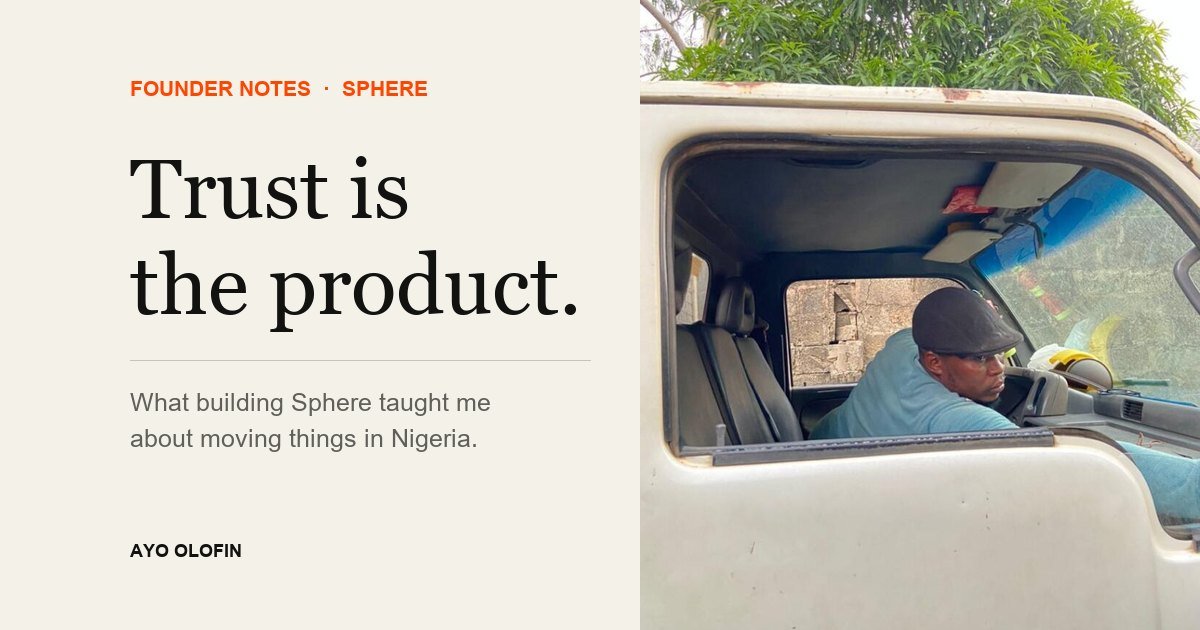
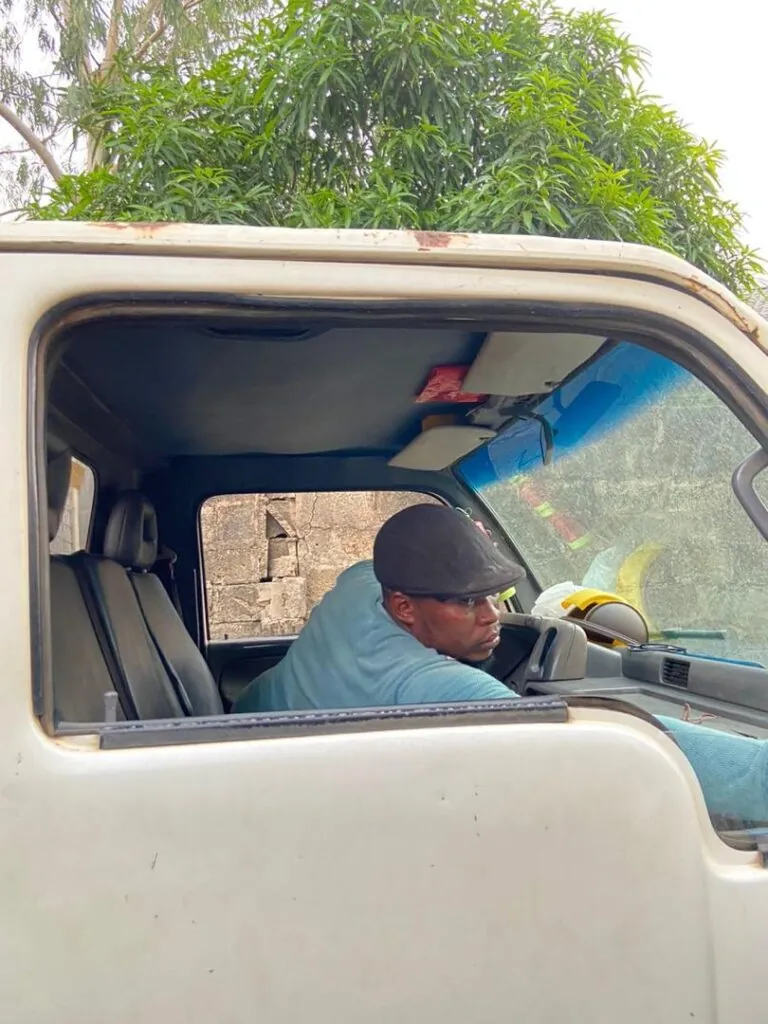
The Ghana Must Go bags are full. The mattress is tied on top with rope. The loaders have collected their money and are arguing with your gateman about who owes who. Then the driver opens the passenger door, and you climb into the front seat of a truck owned by a man you met forty minutes ago, with everything you own sitting behind you.
That is how most moves on Sphere happen. The customer doesn't wave the truck goodbye. They ride with it, beside their fridge, their bed, their TV and the nylon bag with their certificates, all the way to the new place. For the next two hours, through traffic on Third Mainland Bridge or Ikorodu Road, a stranger is in charge of their life and they are sitting next to him, watching.
I have spent the last few years building Sphere, and the most important thing I have learned fits inside that front seat. People think logistics in Nigeria is about trucks, roads and traffic. It isn't. It's about getting one stranger to let another stranger into their house, put their life in his truck and sit beside him in it, at a price both of them believe is fair, and making sure neither of them regrets it.
Trucks are not hard to find in this country. Trust is. Trust is the product.
The CCTV camera that almost disappeared
Sphere began as a frustration, not an idea.
In 2021 we were running a consumer goods e-commerce store in Lagos. (I told the early part of that story in Two Hustling Friends, One Big Idea.) The store was working. We were profitable month after month. And almost every week, I was apologising to a customer.
One order I will never forget was a CCTV camera. We gave it to a dispatch rider for delivery. Somewhere along the way, he lost the customer's number, or never saved it properly. Instead of calling us, he decided the package was now his problem to solve, and he was about to sell the camera to somebody else.
When we found out, we couldn't simply call him and ask for it back. We knew how that conversation would go. So we called him from a different number, pretended to be a new company, and said we had a delivery job for him. He came, thinking he had found a new customer. That is how we got the CCTV camera back. We gave the delivery to another rider.
We laughed about it afterwards, but it stayed with me. The rider didn't steal because he woke up a thief. He did it because nothing in the system made the right thing easier than the wrong thing. He had no record, no rating, no relationship with us worth protecting. And we had no way to reach him except a trick.
At the time I thought I had a logistics problem. Not enough reliable riders, roads that turn a forty-minute trip into three hours, rain that floods half the Island. Those things are real. But the real problem was that nobody in the chain trusted anybody. The customer didn't trust us, so they asked for pay on delivery. We didn't trust the rider, so we called him five times before he left. The rider didn't trust that we'd pay him on time, so he took the better job when it came.
Bad roads slow goods down. Distrust stops them completely.
Why our first answer failed
Our first fix was built on a reasonable idea: if people don't trust each other, put someone trustworthy in the middle.
So we tried an escrow marketplace. The customer pays us, we hold the money, the goods move, and we release the payment when everyone is satisfied. On paper, nobody had to trust the other person. They only had to trust us.
That was exactly the problem. For escrow to work, both sides have to trust the middleman, and trust in Nigeria isn't given. It's borrowed. You get it through clout, through money people can see, or through references from someone both sides already trust. We had none of those. We were a young company nobody had heard of, asking strangers to send us their money.
So neither side trusted us, and when the middleman isn't trusted, escrow doesn't remove the risk. It doubles it. Everybody has done a transfer that stayed "pending" for a week. Everybody knows an agent who collected money and stopped picking calls. We were asking people to bet that we were different, with nothing to show them.
The lesson was uncomfortable: you can't manufacture trust and hand it to people. You can only create the conditions for strangers to trust each other, and then earn your own place slowly.
Two years of building, one launch that failed
We started building the real Sphere in 2023.
I should be honest about where I was. I was a frontend developer. Sphere is a big product: a customer app, a driver app, live locations, offers, verification, payments. It needed to be built in React Native, and I wasn't writing React Native.
We found a developer who was. He started building Sphere, and in September 2023 he got tired and left.
I was stranded. Finding good React Native developers in Nigeria was hard, and finding one at the pay I could offer a bootstrapped company was harder. For months I talked to people who promised and didn't deliver. Every week without a developer was a week the idea stayed an idea.
What kept me going was simple, even if it wasn't easy: I believed in the vision, I believed the problem was real, and I wasn't ready to let it go.
In early 2024, Waris Oloyede came on board fully. He is now my co-founder and CTO, and he brought far more than code. He built what Sphere is today, end to end.
We launched in 2024. It was chaos. The apps were broken, full of glitches, and things failed in front of real customers and drivers. In a business built on trust, a broken app is not a small problem. Every crash tells a customer, "maybe these people are not serious."
So we did the hard thing. We went back, rebuilt it properly, and launched again in 2025.
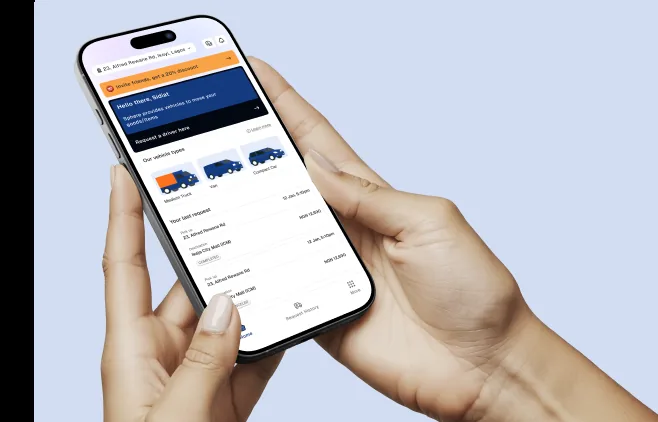
From the outside, a lot of what we rebuilt looks boring. It is. Almost every boring feature exists for one reason: to remove a reason not to trust.
- The customer chooses the vehicle, and each vehicle has a stated weight limit. A compact car for what fits in a boot. A van for a fridge or a washing machine. A medium truck for shop stock. The most common fight on moving day is a vehicle that's too small and a driver who suddenly says, "Madam, this load is too much, add ten thousand." Clarity before the move removes the fight during it. (It's why we wrote a guide on how to describe your load so drivers offer accurately.)
- You can see where your driver is and how far away they are before you choose one. Not because the map is impressive, but because "I'm on my way" is the most distrusted sentence in Lagos.
- Every driver is verified before they take a single job. They submit their driver's licence, a means of identification, their vehicle registration and proof of address. We review everything. If anything is incorrect or incomplete, the application is rejected.
- The price is agreed before anything moves. That one deserves its own section.
The price is where trust starts
Every logistics app I studied had the same answer to pricing: let the algorithm decide. You enter the route, the app shows a price, done. No haggling. That's how it works in the countries these apps came from, and it's what investors expect to see.
We tried fixed prices in 2024. It didn't work.
So we did it differently. On Sphere, the customer proposes a price. Drivers can accept it or make a counter-offer. The customer sees the offers, each driver's rating and how far away they are, and chooses. (Here's how to compare offers on Sphere.)
People tell me this is inefficient. Negotiation is friction, they say. Just set the price.
I understand the argument. I think it's wrong for Nigeria.
We negotiate everything here. At Computer Village, at Balogun, with the keke man, with the mechanic, with the landlord's agent. That's not because Nigerians enjoy arguing. It's because "how much last?" is how two strangers find out whether they can deal with each other. The negotiation isn't a delay before the deal. It is part of the deal.
When a price comes from an algorithm, nobody owns it. If it feels too high, the customer feels cheated by a machine they can't argue with. If it's too low, the driver accepts the job with bad belle, and a driver with bad belle is the one who arrives two hours late, handles your things anyhow and asks for "something for the boys" at the end.
And remember, on most of our moves the customer is sitting right beside the driver. A price one of them resents is a very long ride.
When both people agreed to the price, both of them own it. The argument that usually happens at the destination, in front of your new neighbours, has already happened calmly on a phone screen, before anybody carried a single box.
We didn't remove the haggling. We made it fair: both sides see the information, both sides can say no, and what was agreed is recorded in the app. That turns out to be what people wanted all along. Not the absence of negotiation, but the absence of being cheated.
Drivers have to trust us too
Most marketplace founders call drivers "supply." It's an honest word for how they think about them: a resource on one side of the platform, to be acquired as cheaply as possible.
That word stopped making sense to me the more drivers I met. A man who owns a truck in Nigeria is running a business, and he doesn't owe any platform his loyalty. If one treats him badly, he goes back to the park, where he was finding work long before anybody arrived with an app.
So the trust has to run both ways. Drivers on Sphere keep 90% of what they earn. They see the customer's offer and decide for themselves whether it's worth their time and their fuel.
Mr Taofik is a truck driver on Sphere. Before Sphere, he spent a lot of his time waiting. Waiting for a call, waiting for someone to recommend him, depending entirely on word of mouth.
Since joining Sphere, he has made millions of naira on the platform. Yesterday he did another move, and the customer chose him because of his history on Sphere: his ratings, his completed moves, the record he has built. That record is what the rider with our CCTV camera never had. It's worth more to Mr Taofik than any single job, which is exactly why he protects it.
That's what trust looks like when it's built into a system. Not a promise, but a history that both sides can see.
The problem nobody talks about: cash flow
There's one problem in Nigerian logistics that no app has fixed yet, including ours: cash flow.
A driver can have a job tomorrow and no money for fuel today. A shop owner can need to move stock this week and only get paid by their own customers next week. Moves get delayed not because the truck isn't there, but because the cash isn't.
So we're building a credit system for both sides. Drivers will be able to get an advance for fuel before a job. Customers will be able to move now and pay later. We won't be lending on our own: we're partnering with a licensed financial institution, so the credit is regulated and the people using it are protected.
That only works because of everything that came before it. You can't lend to people you don't know. But a driver like Mr Taofik, with a record of completed moves and ratings behind him, is no longer a stranger. Trust, once it's recorded, becomes something you can build on.
What 260 moves taught me
Sphere is early, and I'd rather say so plainly. As of today, we've completed more than 260 moves for more than 150 customers, with more than 55 partner drivers across Lagos, Abuja and Ibadan. Ninety-six percent of the feedback has been positive.
Those aren't big numbers, and I won't dress them up. Our ecosystem has a habit of making everything sound bigger than it is: "Africa's leading," "thousands of users," "pan-African" when it's one city. I think that habit is a trust problem too. If a company will exaggerate its own numbers to you, what else will it exaggerate? (I wrote about why starting small is the key to getting started.)
We're also a smaller team than we used to be. We were six. Today we're three: Waris, Tola, who runs operations, and me. We make far more use of AI than we did a year ago, and it lets three people do what used to take six. (I've written about how fast AI is changing what small teams can do.)
Small has one advantage: you can know everything. We know our drivers by name. We read every piece of feedback. Our support is there for drivers and customers alike, and when something goes wrong, it reaches us.
And things do go wrong. Four percent of the feedback was not positive. On one move, the driver arrived late because the map pointed him to the wrong place. A location problem, the kind that happens every day in a city where half the streets have two names and the other half have none. We stepped in, sorted it out and got the move done. That customer is one of our returning customers today.
That's what I've learned from the moves that went wrong: trust isn't destroyed when something goes wrong. Things will go wrong in logistics in this country. Rain falls and the road floods. A tyre bursts on the expressway. The map lies. Trust is destroyed by what happens next: silence, excuses, "it's not our fault," nobody picking the phone. And trust is built in exactly the same moment, when somebody picks the phone and owns the problem.
Every move is a life event
There's one more thing I didn't understand when I started.
Nobody requests a truck on an ordinary day. People request one when they're moving into their first self-contain, or into the flat they finally paid two years' rent for. When they're closing a shop at Trade Fair that didn't work out, or opening a new one in Ibadan. When they're relocating to Abuja for a new job, or packing out before December so the children can start the new term in a new school.
One move I think about often was for a woman in a very rural part of Ikorodu. She had been trying to find a way to move for a long time, and nothing had worked. One day she searched online, and Gemini, Google's AI assistant, recommended Sphere. She requested a move and was moved quickly. Her feedback afterwards was amazing.
That alone meant the world to me. Not because of the AI, though I find it remarkable that a machine now recommends us to people we've never met. It's because she had been waiting so long, in a place logistics had simply forgotten, and we were the ones who showed up.
When I understood that, I stopped thinking of Sphere as a logistics company. We're trusted with people at the moments their lives are changing. That's a responsibility, not a transaction.
Trust compounds
Here's what I believe now, after the idea in 2021, the failed escrow, a developer who left, a launch that broke, a rebuild and the first real year live.
Trust is slow to build and quick to lose, which makes it the hardest thing in our market to copy. Somebody can copy our app in a few months. They can't copy the record of every move that went well, every driver who was paid fairly, every problem somebody owned when it went wrong. And as we build credit on top of it, that record becomes more valuable, not less.
Every good move adds a little to it. That's the only growth strategy I fully believe in: do the next move well, and then the next one.
Somebody will still climb into the front seat of a truck tomorrow, beside a driver they've just met, with everything they own behind them. I don't think we'll ever remove that moment of worry completely. What we can do is make sure that by the time they arrive, the worry was for nothing: everything arrived the way it left, at the price they both agreed, with somebody on the other end of the phone if it didn't.
That's the product. The trucks are just how we deliver it.
I believe deeply in Sphere. I believe it will change how logistics is done in Africa and beyond, one trusted move at a time.
Need something moved? Get the Sphere app. Own a truck or van? Drive and earn with Sphere.
Loading the conversation...